Insurance fraud stories don't usually make you laugh. This one might.
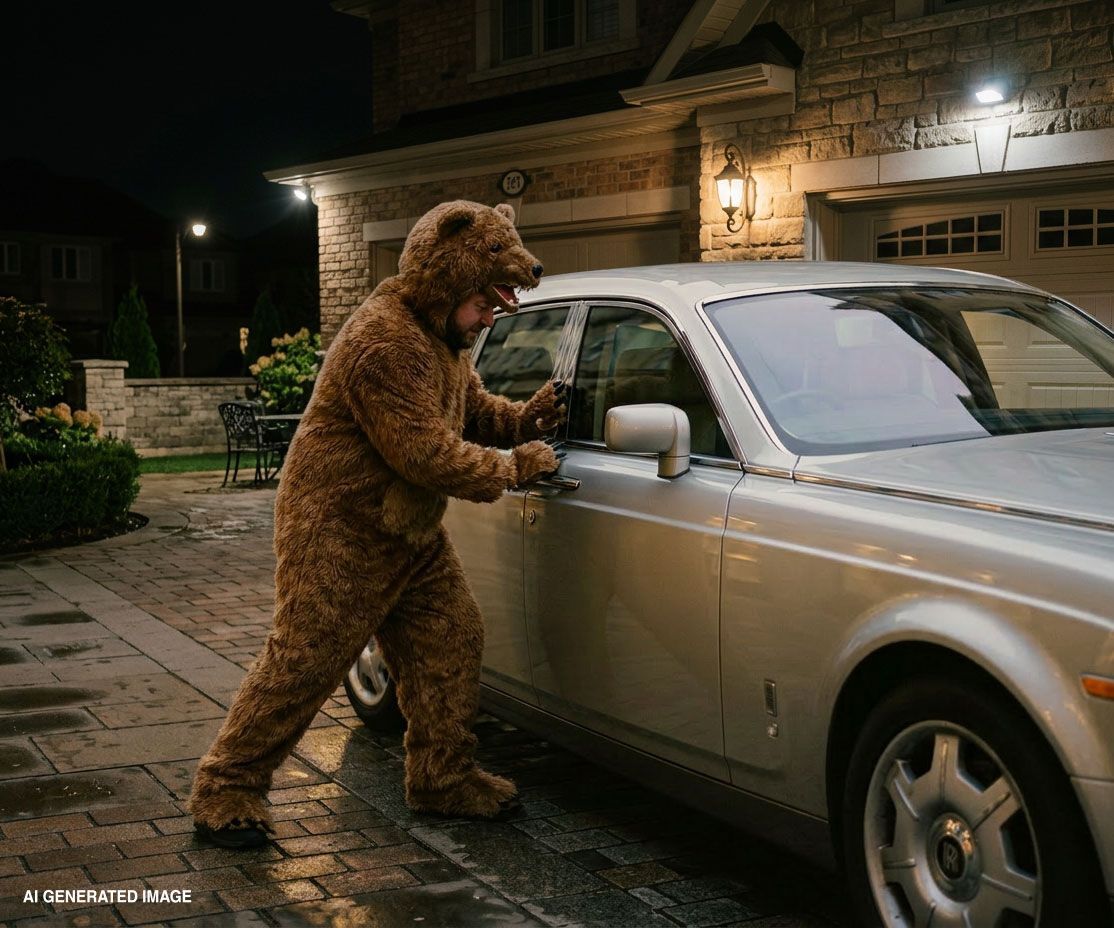
Three Southern California residents were recently sentenced to 180 days in jail after staging fake bear attacks on luxury vehicles to collect insurance money. The scheme involved a person in a bear costume destroying a 2010 Rolls-Royce Ghost and two Mercedes-Benz vehicles, all at the same location in Lake Arrowhead.
They collected more than $141,000 across multiple claims before investigators figured out what was going on.
Here's how it unraveled.
The Bear That Could Open Car Doors
The group submitted video footage of the supposed wildlife encounters to support their claims. It backfired.
Claims investigators reviewing the footage noticed a few problems. The "bear" displayed a suspiciously human ability to open car doors with ease. It also resembled a California grizzly bear, a species that has not been seen in the state since the 1920s.
The insurer flagged the case and referred it to the Department of Insurance, which launched an investigation called "Operation Bear Claw." Investigators soon discovered that the same group had filed identical bear attack claims with two separate insurers on the same date, at the same location, supported by nearly identical videos.
When detectives executed a search warrant, they found the bear costume and the meat-shredding tools used to fake claw marks on the vehicle interiors.
All three pleaded no contest to felony insurance fraud and received six-month jail sentences along with restitution orders.
This Is Funnier Than Most Fraud Cases. The Damage Is Not.
It is easy to laugh at the image of a person in a bear suit trying to unlock a Rolls-Royce. But insurance fraud is a serious problem with real consequences for everyday policyholders.
When someone files a fraudulent claim, the cost does not disappear. It gets distributed across everyone who holds a policy with that insurer. Fraud drives up premiums, tightens underwriting standards, and puts pressure on the claims process for people with legitimate needs.
According to the Insurance Information Institute, fraud accounts for roughly 10 percent of property and casualty insurance losses and loss adjustment expenses in the United States each year. That adds up to billions of dollars annually, and a meaningful portion of that cost lands on consumers through higher premiums.
Insurers take this seriously. Most major carriers employ dedicated special investigations units (SIUs) staffed by trained fraud examiners, former law enforcement officers, and forensic specialists. When something looks off, they look closer.
In this case, a bear that could open car doors and leave damage that looked like it came from a kitchen tool was more than enough to trigger a second look.
What Fraud Investigators Actually Watch For
You do not have to dress up as a bear to raise a red flag. Fraud investigators are trained to spot a wide range of patterns, including:
- Claims filed shortly after a policy is purchased or upgraded
- Incidents involving multiple parties who all know each other
- Damage that does not match the reported cause
- Supporting documentation that looks too similar across separate claims
- Statements from witnesses or claimants that do not hold up under basic scrutiny
- Claims filed on the same date at the same location across different insurers
Modern fraud detection also uses data analytics and cross-carrier databases that can flag unusual patterns across the industry, not just within a single company.
What This Means for You as a Policyholder
If you ever need to file a claim, the most important thing you can do is be accurate and thorough. Honest policyholders sometimes worry that a legitimate claim will be questioned. That worry is understandable, but the best protection you have is a clear, documented account of what actually happened.
Keep records of your property. Take photos and videos of your vehicles, your home, and your valuables. Hold onto receipts and appraisals. When a real loss occurs, documentation speeds up the process and supports your claim.
And if you ever suspect that someone is committing fraud, reporting it helps everyone. Most states have fraud hotlines through the Department of Insurance, and many insurers offer anonymous reporting options.
A Final Note on "Operation Bear Claw"
The investigators who cracked this case were doing exactly what they are trained to do: ask whether the story holds up. In this case, it did not. A bear that has not existed in California for over a century, opening luxury car doors with ease, was always going to get a second look.
Insurance fraud is a felony in most states. The consequences include criminal charges, restitution orders, policy cancellation, and lasting damage to your financial record.
The trio in this case tried to game the system, and it did not work. And as one investigator reportedly noted, it is not every day you see damage that looks suspiciously like it came from a kitchen utensil blamed on a wild animal.
The lesson here is straightforward. Fraud investigators are good at their jobs. And no matter how creative the scheme, the system is built to find inconsistencies.